
Dodge County VINELink Coverage
VINELink is the national public portal for custody information and notifications supplied by participating agencies. For a Dodge County inquiry, select Minnesota and search the custody or offender interface for the exact person. The reporting agency matters because Dodge detainees are commonly housed at Olmsted County Adult Detention Center even though the arrest and court case are tied to Dodge County.
Current research did not locate an official Minnesota participant list that conclusively confirms the exact Dodge and Olmsted feed. Check the live interface before promising coverage. If the person or agency does not appear, use the Dodge Sheriff, ADC, or MNDOC channel that owns the custody record. VINELink also does not replace the federal systems for a BOP sentence, USMS detention, or ICE custody.
- Reporting agency
- The custodian that supplies the status or event to VINE.
- Custody event
- A reported change such as release, transfer, or another configured status update.
- Release record
- The source agency’s maintained entry showing when and why its custody ended.
Search Dodge County VINELink Records
Start with identifiers that can separate people with similar names. Use the spelling in the booking or court record, known aliases, age or birth information where shown, and any agency or offender identifier. A name match alone is weak when the booking agency, date, or personal details do not align.
- Open VINELink and choose Minnesota from the state selection.
- Select the custody or offender search offered in the live interface.
- Enter the exact name or identifier fields presented. Try a documented alias separately when needed.
- Review all matches before opening a record. Compare the reporting agency, name, age or birth detail, identifier, and booking event.
- Open the exact record and preserve the displayed custody label, agency, event date, and event time.
- When a release or out-of-custody result appears, contact the reporting custodian if transfer or another hold is possible.
Do not interpret a zero-result as proof of release. It can reflect nonparticipation, a spelling mismatch, data timing, a different custodian, or a person outside the selected agency’s scope. The Dodge County released inmate lookup explains the separate county, state, court, federal, and immigration routes.
Dodge VINELink Release Fields
The exact display varies by participating agency and record. Read the labels as presented. Do not turn an alert time into a legal release time, and do not assume that a location or event field has the same meaning in every jail system.
| VINELink item | How to read it |
|---|---|
| Name and identifying details | Match the result to the person using more than the name whenever the interface provides more detail. |
| Reporting agency | Identifies whose custody feed produced the result and whose record should confirm it. |
| Custody status | Reports the participant’s current label, which may include custody, released, or out-of-custody wording. |
| Facility or location | Names a reported custodial location when the participant supplies one. |
| Event date or time | Shows the event information supplied to VINE; verify the physical release timestamp with the agency. |
| Notification options | Shows the channels and custody events available for registration on that exact record. |
A “released” or “out of custody” label confirms departure from that reporting participant only. It does not prove the person has no second hold or receiving custodian. If the Dodge or Olmsted record says transfer, follow the named destination.
Register Dodge County Release Alerts
Registration must begin from the correct person’s record. Available channels can include telephone, SMS, email, or in-app delivery at the platform level, but every option may not appear for every agency or record. Choose only the channels and event types offered in the live flow.
- Open the exact matched person record and choose Register or Get Notifications.
- Select an available delivery channel and enter the requested phone number, email address, or account destination.
- Choose release, transfer, or another custody-change event when the record offers it.
- Select a language if that option appears.
- Complete the confirmation process. Telephone registration uses a PIN or confirmation mechanism.
- Test or manage the registration when the service provides those controls, and keep the contact details current.
No fixed PIN length should be published. The rebuilt service uses accounts, codes, and Manage PIN functions, while agency configuration can differ. VINELink help is available at 1-866-277-7477. An alert supports awareness but should not be the sole plan for a time-sensitive pickup or safety decision.
Note: Register only after matching the reporting agency and person; an alert on the wrong record can create a false custody conclusion.
Minnesota DOC Release Notifications
Minnesota DOC maintains a separate custody-status and release-notification route. That path matters when a Dodge County case results in commitment to a state prison. A county VINE registration may end or change at transfer, while DOC controls the later prison and supervised-release record.
The MNDOC Locator is a related status source, not the same tool as VINELink. It covers adults committed to the Commissioner who remain under DOC jurisdiction. An incarcerated result can show Current Status, facility, Sentence Date, Anticipated Release Date, and Expiration Date. A released-to-supervision result can say “Under Supervision as of” and name a district or agent. Final discharge may remove a person from the live Locator, so DOC Central Records becomes the historical path.
Conversely, DOC notification does not cover a Dodge booking that never became a state commitment. For that person, the Dodge or Olmsted custodian remains the source. Always register and verify in the system tied to the actual custody type.
Dodge VINELink Interface View
The official VINELink portal provides the state selection, person-search, detail, and notification workflow used for a Dodge County check.
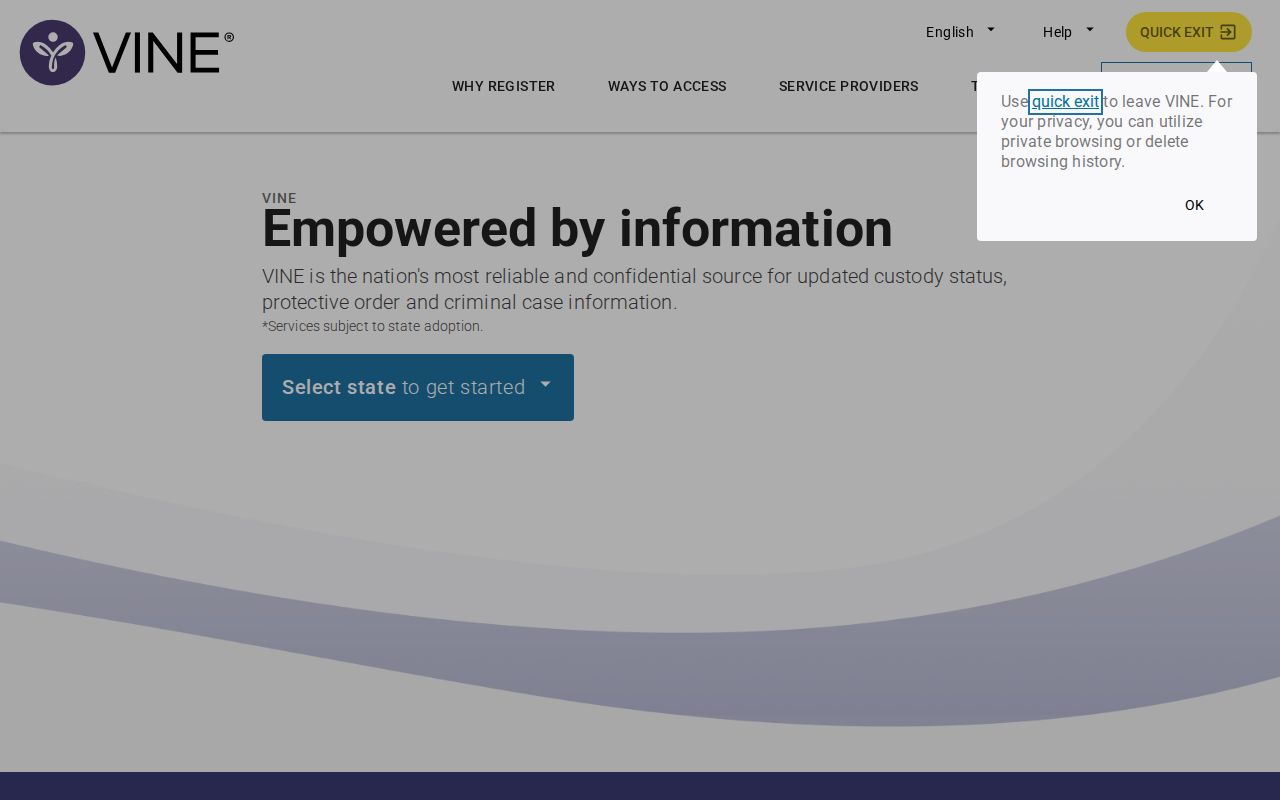
The screen supports a live person-and-agency check, but the originating custodian’s record remains the source for the precise legal basis and physical release time.
Dodge Alert Time Versus Release
Three times can differ in a VINELink inquiry. A court may first authorize release. Olmsted ADC may later complete physical processing and enter the custodian’s release event. VINELink may then send an alert after the participant’s data feed receives that event. Only the agency entry establishes the physical departure time, while the court order establishes the legal authorization.
This distinction is especially important for bail. Olmsted ADC warns that the wait can be long after payment, and the payer does not need to stay. A VINELink alert should not be used to predict the pickup minute from the bail receipt. Call the facility for an urgent pickup question. Then request the maintained release record when an exact time and basis are needed.
Transfers require the same care. If VINELink reports departure from one participant, the person may appear in another jail, MNDOC, BOP, ICE, or another lawful custodian. Describe the first event only as departure from the reporting agency until the destination is known.
Dodge VINELink Search Failures
A missing VINELink result has several possible causes. The agency may not participate, the name may differ from the booking record, the person may be housed by another custodian, or the event may not yet have reached the platform. Dodge’s boarding arrangement adds one more check: search for the actual Olmsted ADC reporting path when the person was jailed for a Dodge case.
Compare results with the current Dodge custody list, which displays name, booking time, photograph date, charges, and current hold descriptions. Those details can help identify the correct booking, but the roster has no release archive. For a state commitment, search MNDOC by name or Offender ID and read Current Status first. Newly sentenced people may take several business days to appear.
Name-only matching also fails when a person uses an alias, compound surname, changed name, initials, or a different spelling across jail and court systems. Preserve the source spelling and use identifiers wherever available. A zero-result should remain a zero-result, not be converted into a release finding.
Dodge VINELink Release Limits
VINELink is an alerting and corroboration layer. A notification follows a data-feed event, so it may arrive after the legal or physical release time. Technology problems, participant configuration, or contact failure can also affect delivery. Preserve the exact label and alert time, then compare them with the agency’s maintained release entry.
The service is not the BOP locator. For a federal sentence, use the BOP Inmate Locator, which covers federal inmates from 1982 to the present. A BOP release date or “Not in BOP Custody” result is limited to BOP and does not rule out another sovereign. USMS pretrial custody lacks an equivalent public historical locator, so the federal docket and holding facility matter. ICE uses its own Online Detainee Locator and field-office route.
Confirm Dodge County VINELink Releases
For a Dodge jail event, ask Dodge Sheriff Records for the public adult release date, time, and legal basis under Minn. Stat. § 13.82, subd. 2. If Olmsted ADC maintains the physical booking or processing entry, request a referral or contact ADC. Then review the Dodge District Court case to explain whether bond, conditions, a dismissal, sentence completion, or another order authorized release.
If the record names a receiving agency, check that system. An MNDOC entry may show incarceration or community supervision after state-prison release. A federal transfer calls for the docket, USMS, and later BOP status. An immigration transfer calls for ICE ODLS or ERO. Keep the scope of each source clear.
The best conclusion uses two independent records. The custodian’s release entry establishes when and why its custody ended. A court order, supervision record, or receiving-agency entry establishes what followed. VINELink can alert the user to start that check, but it does not merge those distinct legal events into one certified history.