
Dodge County Scheduled Versus Actual Release
A projected date is a calculation. It is not the time a person will walk out of a facility. The Minnesota DOC Locator uses the exact label “Anticipated Release Date” for an incarcerated person when the field applies. That date forecasts movement from the prison portion of a sentence. The same detail may show an Expiration Date, which is the end of sentence or DOC jurisdiction. Those fields are not interchangeable. A later detail may say “Under Supervision as of” and name a district or agent, which supports release into the community portion but still does not give a gate timestamp.
Dodge County jail custody follows a different path. People arrested on Dodge matters are physically held through the Olmsted County Adult Detention Center arrangement. A pretrial detainee has no fixed sentence release date. Bail or a judge’s order can authorize release, but ADC processing must still finish. For a sentenced jail term, use the actual warrant of commitment, jail credit, court order, and custodian calculation. No official Dodge or Olmsted local good-time formula was found, so the state prison formula must not be copied onto a county jail sentence.
- Anticipated Release Date
- MNDOC’s forward-looking field for prison release when applicable.
- Expiration Date
- The endpoint of the sentence or DOC jurisdiction, not the prison exit date.
- Jail credit
- Custody time applied under the sentencing and commitment record.
- Detainer
- A request or legal basis for another authority to take or continue custody.
Find Dodge County Projected Release Dates
The correct route turns on who holds the person. The live Dodge list proves only current display in the Dodge and Olmsted custody system. It has no projected-release field. MNDOC Locator covers adults committed to the Commissioner who remain under DOC jurisdiction, including incarcerated people and people already released from prison but still supervised. It does not cover every Dodge detainee or every fully discharged former prisoner.
- Classify the case as Dodge or Olmsted jail custody, a Minnesota prison sentence, work release, or another sovereign’s custody. Do not use a state prison date for a local jail stay.
- For state prison, search the MNDOC Locator by first and last name or MNDOC Offender ID. Newly sentenced people may take several business days to appear.
- Open the exact record. Read Current Status first, then Sentence Date, Anticipated Release Date, Expiration Date, offense, court-file number, facility, and caseworker or agent fields that appear.
- For a Dodge county sentence, obtain the sentencing order and warrant of commitment through MCRO or Dodge Court Administration. Ask the physical custodian for its date calculation and applied jail credit.
- For a fully discharged state prisoner missing from Locator, request the public release and sentence chronology from MNDOC Central Records. Provide the name, birth date if known, MNDOC ID, court case, and approximate dates.
- Near the expected event, confirm with the custodian. An alert or court order can precede the actual processing time.
The broader Dodge County released-inmate record path covers the final county release timestamp and whether the person entered the community or transferred to another agency.
Note: A Locator no-result does not prove a Dodge jail release, no state incarceration, or a completed historical DOC discharge.
Dodge County MNDOC Date Fields
Locator search results can begin with the letters entered and may include conviction-associated names. Identity matching matters. An incarcerated detail can show “Incarcerated as of,” the facility, Sentence Date, Anticipated Release Date, Expiration Date, caseworker, highest-ranked offense, and court-file number. A supervised result can show “Under Supervision as of,” a district, and an agent. A work-release result can say “Assigned to Work Release as of.” That last phrase describes a structured status, not full discharge.
| Locator field | What it establishes | What it does not establish |
|---|---|---|
| Current Status | DOC’s present status statement as shown | The full history or county jail status |
| Anticipated Release Date | A forward-looking prison release calculation | A guaranteed gate date or time |
| Under Supervision as of | Community supervision under DOC jurisdiction from the stated date | The exact physical prison-exit time |
| Expiration Date | The sentence or jurisdiction endpoint | The prison release date |
| District and agent | The state supervision assignment displayed | That Dodge local staff supervise the person |
The official MNDOC example shows the Anticipated Release Date label in context.
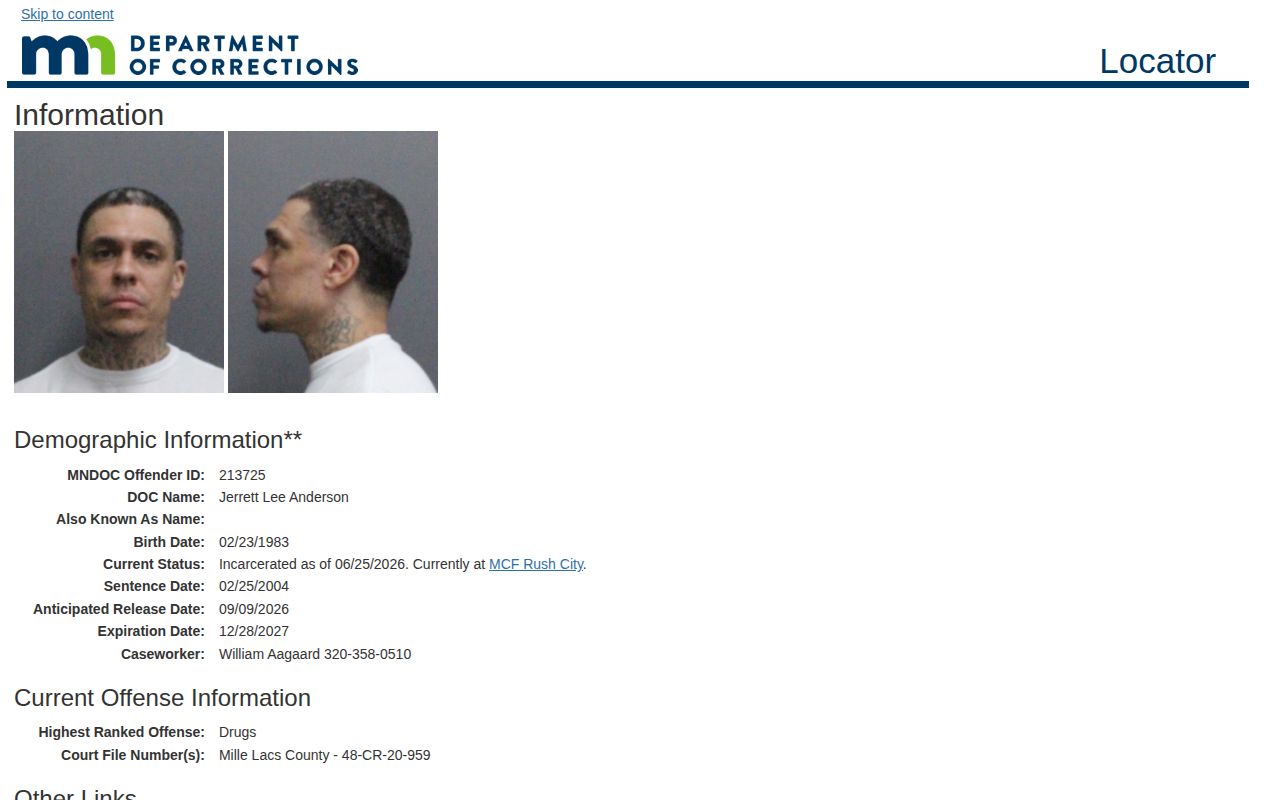
The image demonstrates which field to read, while the individual record and custodian must confirm any later change or completed release.
Minnesota Dodge County Sentence Baseline
For an ordinary fixed executed felony sentence for an offense on or after August 1, 1993, Minnesota Statutes section 244.101 divides the term into a minimum prison portion of two-thirds and a maximum supervised-release portion of one-third. Minnesota is not an “about 85 percent” jurisdiction for this baseline. A simple 36-month illustration produces 24 months of imprisonment and 12 months of supervised release before case-specific changes. It is an illustration, not a forecast for a named person.
Section 244.05 provides that supervised release ordinarily starts after the prison term plus any disciplinary confinement. Time added for discipline can delay physical release and shorten the community portion. It is therefore wrong to promise that every eligible person will spend exactly one-third of the total term in the community. Concurrent or consecutive terms, jail credit, offense-specific law, sentence corrections, and specialized Board action can also change the operational calculation.
Traditional good time under section 244.04 mainly concerns qualifying crimes before August 1, 1993. Its one-day-for-two discipline-free structure can explain an old record, but it is not the rule for a newly sentenced Dodge County defendant. Life, old indeterminate, and some youth-at-offense cases may follow specialized minimums and Board review.
Dodge County MRRA Release Credit
The Minnesota Rehabilitation and Reinvestment Act creates a separate earned-incentive framework. Sections 244.43 through 244.45 tie credit to programming and policy. The statute caps earned incentive release credit at 17 percent of the total executed sentence, prevents confinement from falling below half of that sentence, preserves the total supervised-release term, and excludes specified life, old indeterminate, and traditional good-time populations.
Implementation is phased. No one should subtract the maximum percentage from a displayed Dodge County projected release date and present the result as official. The individual may not be eligible, may not have earned the maximum, or may have another part of the sentence calculation that controls. The official date shown in Locator and the calculation held by DOC are the proper sources.
For calculation detail, contact MNDOC Central Records at co-records.doc@state.mn.us, 1450 Energy Park Drive, Suite 200, Saint Paul, MN 55108, or 651-361-7200. Ask for the maintained public sentence chronology and the basis of the current anticipated date. No fixed fee or universal turnaround was established in the Dodge research.
Note: MRRA credit is earned and case-specific; the statutory cap is not an automatic reduction from every Minnesota prison sentence.
Dodge County Release Date Changes
A date can change even when the original sentence stays in place. The key is to identify which agency action changed which field. A court amendment changes the legal sentence. DOC discipline affects prison time. A detainer may change where the person goes after one custodian releases them. A Board decision may control only a limited eligible case and can impose conditions that must be satisfied first.
| Factor | Possible effect | Best source |
|---|---|---|
| Disciplinary confinement | Delays prison release and can reduce remaining community time | DOC status and calculation record |
| MRRA earned credit | May adjust confinement within statutory cap, floor, exclusions, and policy | DOC calculation and Locator date |
| Consecutive sentences | One term begins after another and moves the operational date | Sentencing orders and DOC chronology |
| Detainer or transfer | Ends custody with one agency but sends the person to another | Custodian release entry and receiving agency |
| Court correction or appeal | Changes the controlling sentence or commitment | Dodge court order |
| Board or release-plan action | May deny, continue, condition, or set later action in eligible cases | Approved Board minutes and later DOC status |
A Board grant does not always mean release to the community. It can depend on plan approval or start a consecutive sentence. A later Locator supervision status or DOC release record is needed to establish physical departure.
Dodge County Release Calculation Quirks
Minnesota’s weekend and holiday direction is tied to state prison supervised release and an offense-date line. Under section 244.05, subdivision 1a, a scheduled date for a crime before August 1, 1992 moves to the prior eligible day that is not Friday, a weekend, or a holiday. For later crimes, the date moves to the first following eligible day. This is a narrow state rule. It is not evidence of an Olmsted ADC weekend practice.
No official Dodge or Olmsted source published a local weekend-release formula, fixed exit schedule, or local good-time calculation. For a county sentence, request the custodian’s computation based on the warrant of commitment, credited time, and court order. If bail or an order authorizes release, distinguish authorization time from physical release after ADC processing.
This is the central Dodge County date quirk: the correct rule changes with the custodian. State prison law governs MNDOC calculations. The jail and court records govern a local sentence. Applying one formula to both can produce a confident but false answer.
Confirm Dodge County Actual Release
Near the anticipated date, read the latest Current Status and contact the holding facility or DOC. A released-to-supervision record may state “Under Supervision as of” and identify the district or agent. For the precise prison-exit timestamp and legal release type, request the underlying DOC release record. For a Dodge or Olmsted jail event, request the public date, time, and legal basis under Minnesota Statutes section 13.82, subdivision 2.
VINELink may provide a release or custody-change alert if the actual Dodge or Olmsted custodian participates, but current official participation was not conclusively documented in a static Minnesota list. Notification time can lag the source event. The dedicated VINELink Release Check explains how to match the reporting agency and register without treating an alert as the official gate time.
A sound final statement names the source and scope: MNDOC displayed an anticipated date; the court authorized release; or the custodian recorded the actual departure. Those are three different facts. If a receiving agency takes custody, describe the event as a transfer rather than a community release.
Note: The most recent custodian record controls the physical event, while the court order controls the legal authorization and MNDOC controls state sentence status.